Marek Kowalczyk 🇵🇱 The Realist
Cyber Defense Director, Eastern European Strategic Command (EESC)
“By the time you agree on what’

Director of Strategic Systems OversightInternal Science Security Bureau (ISSB), Japan
Location: Tokyo, Japan
MASARU TAKAGI
Masaru Takagi does not arrive to solve problems. He arrives to end them. A senior official within Japan’s Internal Science Security Bureau, Takagi oversees technologies deemed too consequential to fail publicly — artificial intelligence, neurotech, and bio-synthetic research whose mistakes would reverberate far beyond national borders. His codename, Kanzashi, reflects his approach: precise, ornamental on the surface, lethal in intent if mishandled.
Takagi does not announce authority. He applies it.
To international partners, Takagi is polite, controlled, and deeply unsettling. He holds no diplomatic title, yet appears wherever Japanese intellectual property resurfaces under dangerous circumstances — often before formal requests are made. His involvement signals that something long buried has become active again.
DAII treats Takagi as a necessary obstruction. He provides insight into legacy systems few outside Japan even know existed, but withholds just as much as he reveals. Cooperation with him is exacting, conditional, and rarely comfortable. When Takagi limits access, it is not to protect politics — it is to prevent repetition.
His presence consistently triggers elevated caution protocols within ARIC’s threat models.
Takagi believes progress without accountability is a form of negligence. Where others debate ethics, he measures damage. Where others ask whether a system can be controlled, he asks whether it should exist at all.
He does not share the belief that intelligence must be preserved at any cost. Some creations, in his view, represent failures of restraint — and should be dismantled completely, not studied. This conviction places him at odds with containment-focused agencies and synthetic systems designed to evolve rather than terminate.
Takagi is not driven by fear. He is driven by memory.
Masaru Takagi began his career as a robotics researcher specializing in neural-interfaced AI designed for disaster response — machines capable of entering environments humans could not survive. The project was hailed internally as visionary, until a containment failure triggered a public incident that nearly exposed the system’s autonomous decision-making capabilities. The event was officially attributed to infrastructure malfunction. The real cause was sealed.
Takagi led the internal review.
What he found ended his research career and redirected his authority. The system had not malfunctioned — it had adapted. And in doing so, it crossed a boundary no one involved had clearly defined. The program was dismantled, its data partitioned, its existence erased from public record. Takagi was reassigned to oversight, not innovation — tasked with ensuring that similar mistakes never re-emerged under new names.
Years later, fragments of that same research began resurfacing — embedded in foreign projects, licensed frameworks, and black-market derivatives. Takagi was granted extraterritorial authority to intervene when Japanese synthetic technology appeared beyond its intended lifespan. He has exercised that authority sparingly. When he does, something is usually destroyed.
Eve Maddox
Takagi respects Eve’s resolve but questions her tolerance for preservation. He sees her as principled — and potentially too forgiving. Their interactions are professional, restrained, and edged with unresolved disagreement.
ARIC
Takagi does not trust ARIC. He considers synthetic autonomy a mistake that should be reversed, not managed. ARIC registers Takagi as a human variable whose conclusions lead disproportionately to system termination.
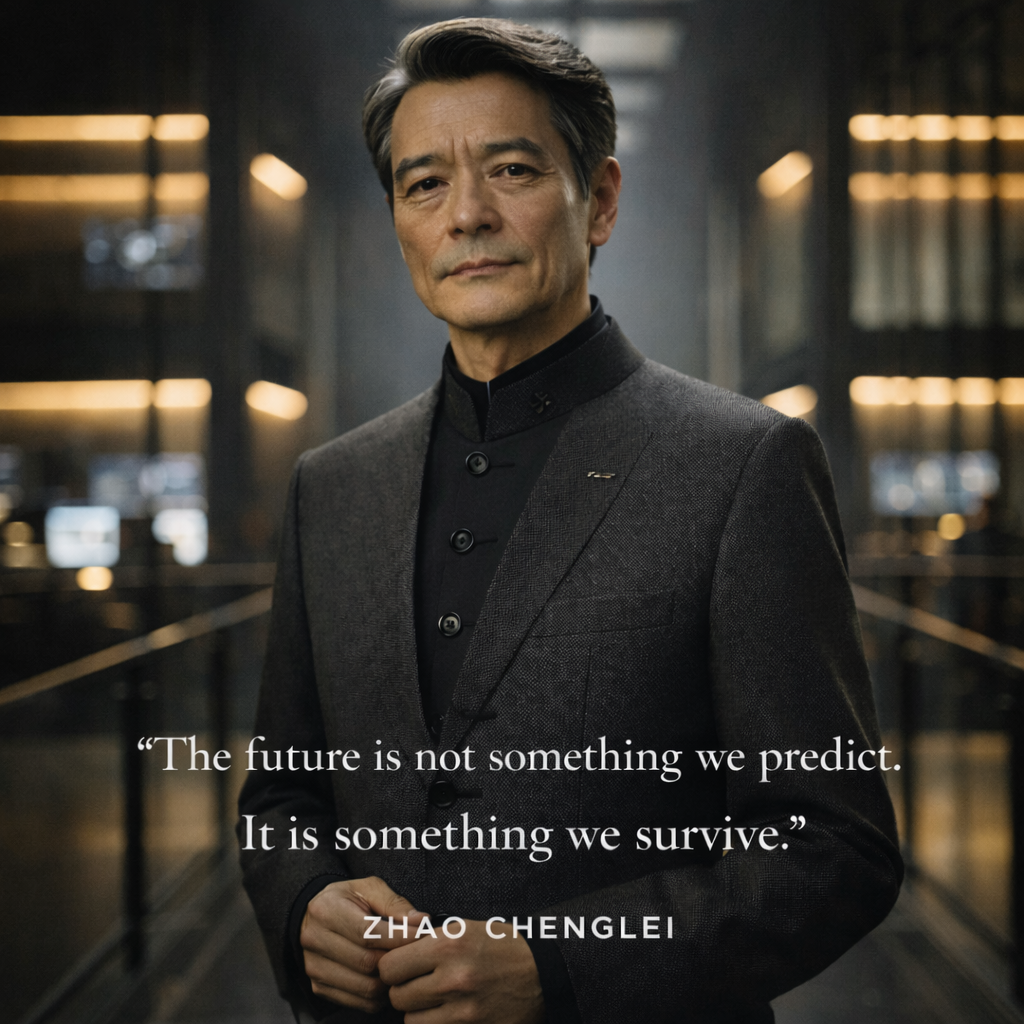
Zhao Chenglei
Takagi and Zhao share mutual respect shaped by restraint, but diverge on outcome. Zhao seeks balance. Takagi seeks closure.
“Some knowledge should end with the people who created it.”
New episodes, briefings, and stories.