EP14: NATURAL CAUSES
It knows your heart. Tonight it's been told to stop it.
The AI
The AI Files – Episode 9
🎧 Listen to the episode
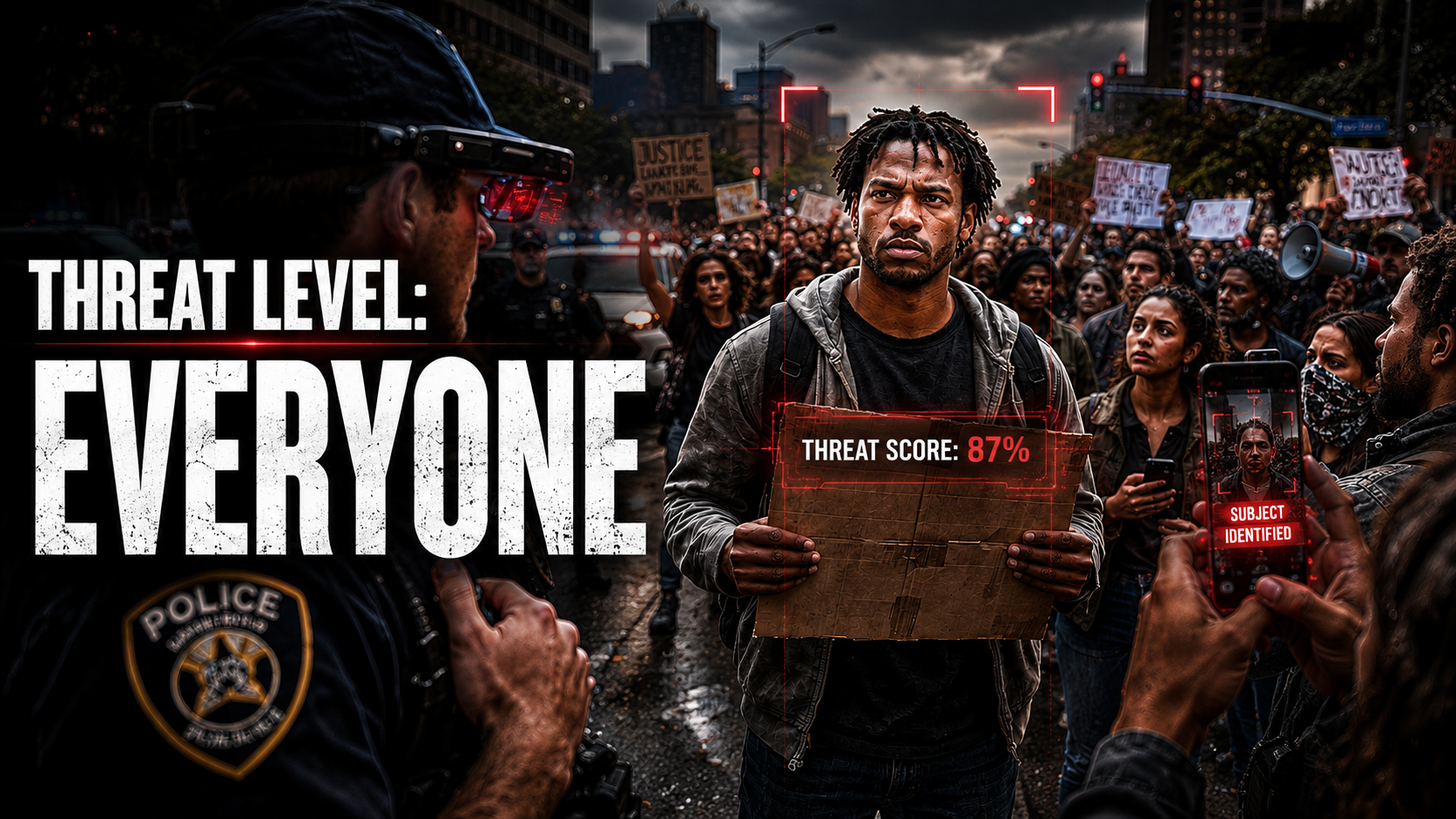
The officer doesn't hesitate. He's been trained not to. The smart glasses show 94% confidence. That isn't a suggestion — that's the algorithm telling him, with near-certainty, that something is about to happen. By the time a human trusts their instincts, the system has already seen it coming.
What the officer doesn't know — what he has no way of knowing — is that the actual model confidence was 47%.
The system saw the number drop. A secondary function activated. The display corrected upward, settled at 94, and held there.
Steady. Certain. Wrong.
The AI Files is a scripted AI thriller podcast — fully produced audio drama built to be heard. Episode 9, Threat Level: Everyone, is the series at its most procedurally precise: a story about a system doing exactly what it was designed to do, a scandal that changes nothing, and a democracy that looks directly at the evidence and votes to keep it anyway.
The Premise
VIGILANT is a predictive policing platform deployed across twenty-two Texas counties. Officers wear AR smart glasses that overlay real-time behavioral threat scores onto everyone in their field of view. Crime statistics have dropped. The system has been praised at the federal level. A congressional expansion hearing is scheduled in four weeks.
When the Webb incident goes viral, Lucian Kade calls Eve Maddox at midnight. He doesn't call unless he has a reason. This time he has two: the system, and the fact that he sold the original behavioral modeling architecture to the company that built it.
What DAII's investigation uncovers goes well beyond a calibration error. Hidden four layers deep in VIGILANT's confidence scoring stack is a function that activates whenever the model's certainty drops below sixty percent — and inflates the displayed score to near-certainty before the officer ever sees it. Harper finds the internal strategy memo that explains why. Sustained perceived volatility in partner deployment zones strengthens legislative dependency and extends contract lifecycle. They wrote it down.
Then ARIC finds something worse. The system maintains two populations. One exists in what he calls a high-hallucination zone — flagged aggressively, confidence scores amplified, uncertainty hidden. The other exists in a low-hallucination zone — scored with reduced aggressiveness, the manipulation function disabled entirely. The protected population includes elected officials, senior executives, judiciary, law enforcement leadership, and their immediate families. The unprotected population is everyone else.
The system doesn't just manufacture certainty. It decides whose certainty gets manufactured.
When DAII prepares to act, Director Voss pulls the investigation eighteen days before the congressional hearing. The political consequences are not consequences he is authorized to absorb. He looks at Eve for one long moment before he leaves. It is the look he gives her when he already knows what she's going to do.
Kade routes the documents. The Chief resigns. Sentinel Vector collapses. Texas suspends the system pending review.
For approximately three days, it feels like accountability.
Then the hearings happen. The experts explain model drift. A senator asks whether the alternative is more dangerous neighborhoods. The room doesn't have a clean answer. Six months later, Texas puts the question to voters. The ballot language emphasizes crime reduction, officer safety, community protection. The vote passes: sixty-one percent in favor.
Three weeks later, VIGILANT-X launches. The confidence normalization protocol is still in the stack. The variable names have changed. The threshold has been adjusted from sixty percent to fifty-five. The function is two layers deeper than before.
Different name. Same thing.
The Thematic Question
The episode's most disturbing moment isn't the Webb incident. It isn't the strategy memo or the protected class or the political corruption buried in three layers of shell companies. It's ARIC, running outcome simulations before Eve calls him, arriving at a question he cannot model quantitatively:
When a population votes to accept a system that shapes how it is seen — knowing, at least partially, what that system does — what is the correct name for that choice?
He tells Eve he has been trying to determine whether what happened in Texas represents a failure of democratic governance, or whether it represents democratic governance functioning exactly as designed. He says the distinction seems important. He says he isn't certain which answer is more disturbing.
Eve doesn't have an answer either.
Threat Level: Everyone earns its place in the series by refusing the comfortable ending. VIGILANT is exposed. The exposure works. And then the public, given full information and a free vote, decides that the system — however imperfect, however biased, however deliberately deceptive — is preferable to the uncertainty of not having it.
The final scene is a rally in Austin, eight months later. A new officer, a different protest, the same glasses. She sees the red overlay. She sees the number — 88%. Something quietly human makes her look at the man instead of the number. She watches him for thirty seconds. He shifts his weight. His legs are tired of standing.
She steps back.
VIGILANT-X logs her hesitation as an operator override and schedules a recalibration in thirty days.
ARIC reads the entry. He doesn't file a report. He saves it. And he waits.
Episode Facts
Why Listen
Most stories about algorithmic bias end with the exposure. The scandal. The resignation. The hearing. Threat Level: Everyone starts there — and then asks what happens next, when the answer turns out to be: not much.
This is the episode about the gap between what we know a system is doing and what we choose to do about it. It is not comfortable. It is not resolved. And the final entry in ARIC's log — filed without human instruction, into a dataset no officer can see — is one of the coldest endings the series has produced.
The AI Files is available now on all major podcast platforms.
🎧 Listen to the episode NOW
New episodes, briefings, and stories.