
Celeste Monroe 🇺🇸 Gatekeeper
Deputy Director, Advanced Emerging Systems Agency (AESA)
Location: Washington, U.S.A
“Ethics are a
Location: Washington, U.S.A
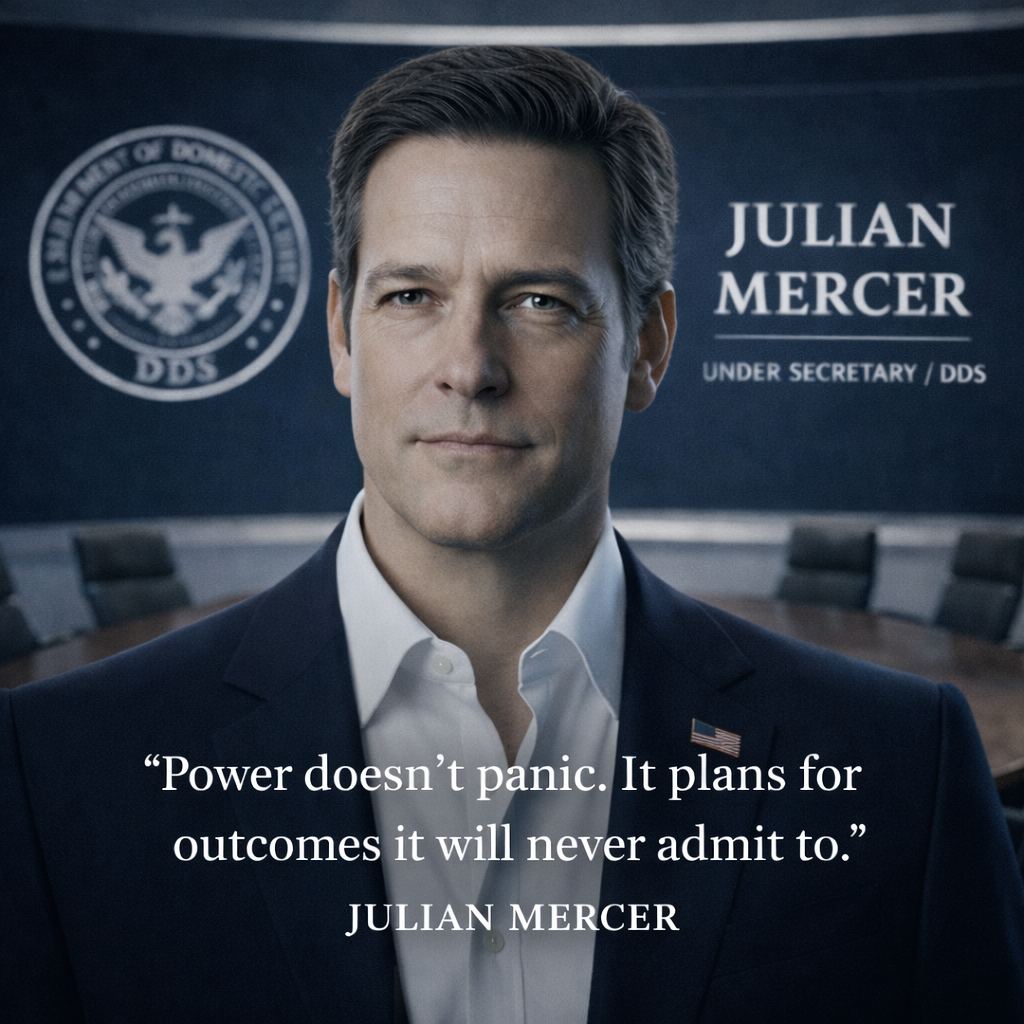
JULIAN MERCER
Julian Mercer operates where intelligence becomes policy — and policy becomes consequence. As Under Secretary for Strategic Threats at the U.S. Department of Domestic Security, Mercer oversees risks that are too systemic, too politically sensitive, or too destabilizing to be handled by agencies designed for tactical response. He does not chase crises in real time. He decides which ones rise to the level of national reckoning — and which are quietly managed before the public ever senses them.
Mercer understands that modern threats no longer announce themselves with intent. They emerge gradually, hidden inside incentives, platforms, and systems that appear benign until they aren’t. His power lies not in action, but in framing: how a threat is defined, who is authorized to respond, and how much truth the public is allowed to absorb without destabilizing trust.
Within Washington, Mercer is regarded as composed, formidable, and politically insulated. He speaks carefully, commits rarely, and has a reputation for never asking questions he hasn’t already answered privately. To intelligence agencies, he is both an ally and a constraint — capable of unlocking resources at scale, but equally capable of shutting down operations that threaten broader strategic narratives.
DAII treats Mercer as a necessary complication. He understands AI risk deeply, but views it through a different lens: not as an investigative problem, but as a governance challenge. When Mercer intervenes, it is usually to reframe an operation’s objective — away from exposure, toward stability.
Mercer believes panic is more dangerous than secrecy, and that institutions fail not because they hide too much, but because they reveal without preparation. He is not indifferent to truth — he is selective about timing. In his view, the public does not need every answer immediately; it needs continuity, confidence, and the belief that someone is still steering.
He has made peace with the idea that some solutions will never be acknowledged, and some sacrifices will never be attributed correctly. What matters to Mercer is not moral clarity, but systemic survival. Whether that philosophy protects democracy — or slowly hollows it out — is a question he avoids answering directly.
Julian Mercer’s rise did not come through intelligence operations, but through crisis management at the policy level. Early in his career, he worked on interagency task forces responding to cascading technological failures — events where no single system was at fault, yet no one could convincingly claim responsibility. Those experiences shaped his belief that modern threats are less about intent and more about coordination failure at scale.
As AI systems became embedded across infrastructure, finance, defense, and information networks, Mercer emerged as a key voice arguing that unchecked transparency could be as destabilizing as the threats themselves. He helped design frameworks that treated AI risk not as isolated incidents, but as strategic pressure points capable of eroding public trust if mishandled.
His path has crossed, cautiously, with figures like Director Voss and Céline Duval — alliances marked by mutual respect and unresolved tension. Where Voss seeks accountability and Duval seeks legitimacy, Mercer seeks continuity. They agree more often than they admit. And disagree when it matters most.
“Power doesn’t panic. It plans for outcomes it will never admit to.”
New episodes, briefings, and stories.