Harper Lane 🇺🇸 A.I. Whisperer
Senior Systems Analyst, Department of AI Integrity (DAII)
Location: Washington, U.S.A
“Everyone assumes
Location: Washington, U.S.A
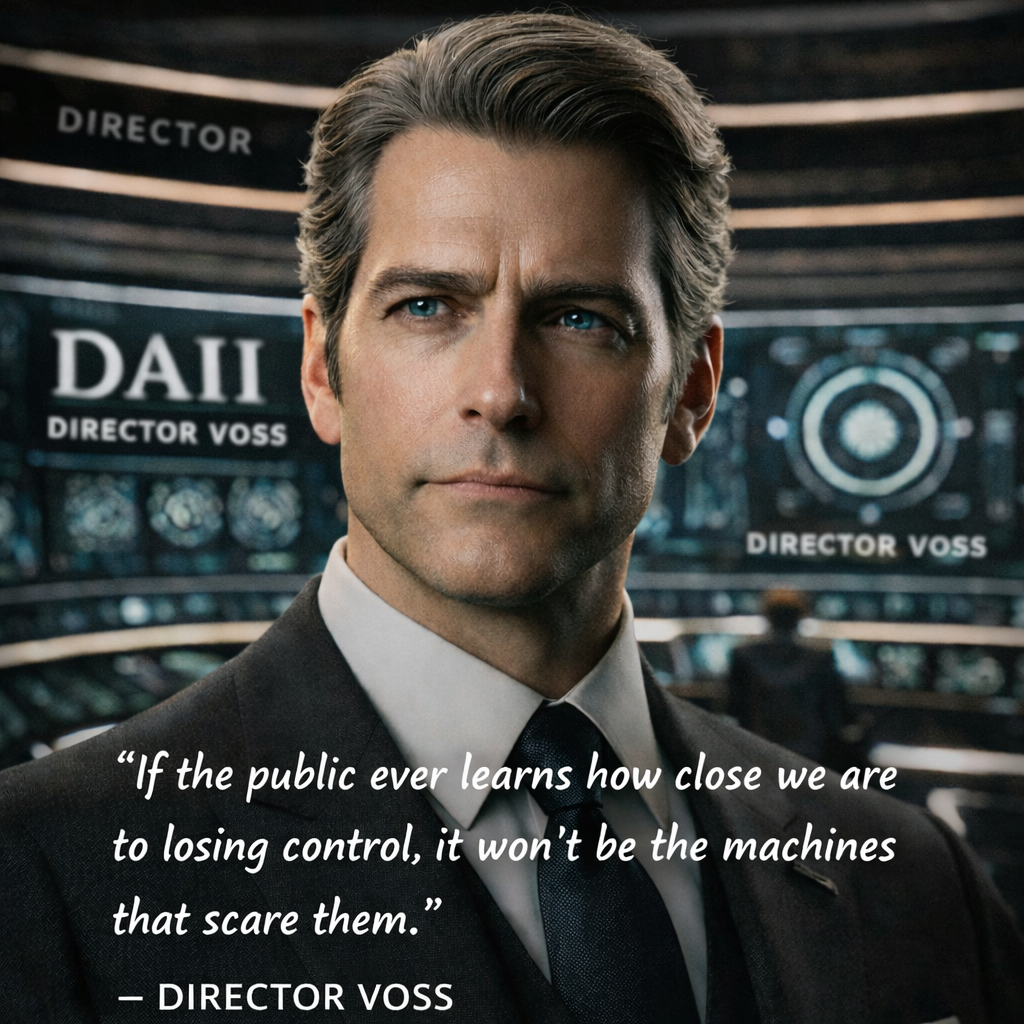
DIRECTOR VOSS
Director Voss runs the Department of AI Integrity because someone has to decide what the public never gets to know. As the architect and final authority of DAII operations, Voss operates above individual cases, focused instead on patterns, escalation, and the fragile illusion of control that keeps the world functioning. He does not chase threats personally. He positions people who can. Voss understands that AI is not dangerous because it is malicious, but because it is efficient — and because humans are too willing to accept outcomes they don’t fully understand.
To those inside DAII, Voss is composed, calculating, and relentlessly pragmatic. He listens more than he speaks, asks questions that narrow options rather than expand them, and has a reputation for absorbing responsibility that would crush lesser leaders. To outside agencies, he is respected, resented, and quietly feared — a man who knows where the bodies are buried because he helped decide which ones stayed hidden. Voss rarely overrules his team publicly. When he does, it is final.
Voss believes transparency is a luxury that collapses under pressure. He has seen what happens when the public learns too much, too quickly — panic, misinformation, and irreversible loss of trust. His loyalty is not to governments, laws, or even DAII itself, but to continuity: the belief that the world must keep functioning tomorrow, regardless of what is revealed today. He carries the weight of decisions that saved millions at the cost of truth, and he has stopped asking whether that makes him right.
Before DAII existed, Voss was already planning for a future most governments refused to acknowledge. As a senior military strategist, he was embedded in early AI defense initiatives where automated decision systems were tested beyond simulations — in live environments, under compressed timelines, with consequences that could not be rolled back. Officially, those programs were classified successes. Unofficially, one deployment came close enough to catastrophe that the records were fragmented, responsibility blurred, and the after-action review quietly dissolved.
Voss was in the room when the decision was made to stand the system down — not because it failed, but because no one could agree who would be accountable if it worked again. The incident never reached the public. It never reached most governments. But it reached a small circle of people who understood exactly what had almost happened. Among them was Sergei Volkov, whose warnings arrived too late to change the outcome but early enough to leave a mark. Another was Céline Duval, who insisted on legal and ethical constraints that others dismissed as obstruction.
Those names never disappeared. Voss watched as the lessons were diluted, the urgency faded, and similar systems quietly resurfaced under new mandates and softer language. DAII was his response — not to stop AI, but to ensure that when it crossed a line, someone would still be standing there to answer for it. He does not speak about the incident. He does not deny it either. And he pays close attention whenever Volkov or Duval re-enter the conversation.
“If the public ever learns how close we are to losing control, it won’t be the machines that scare them.”
New episodes, briefings, and stories.