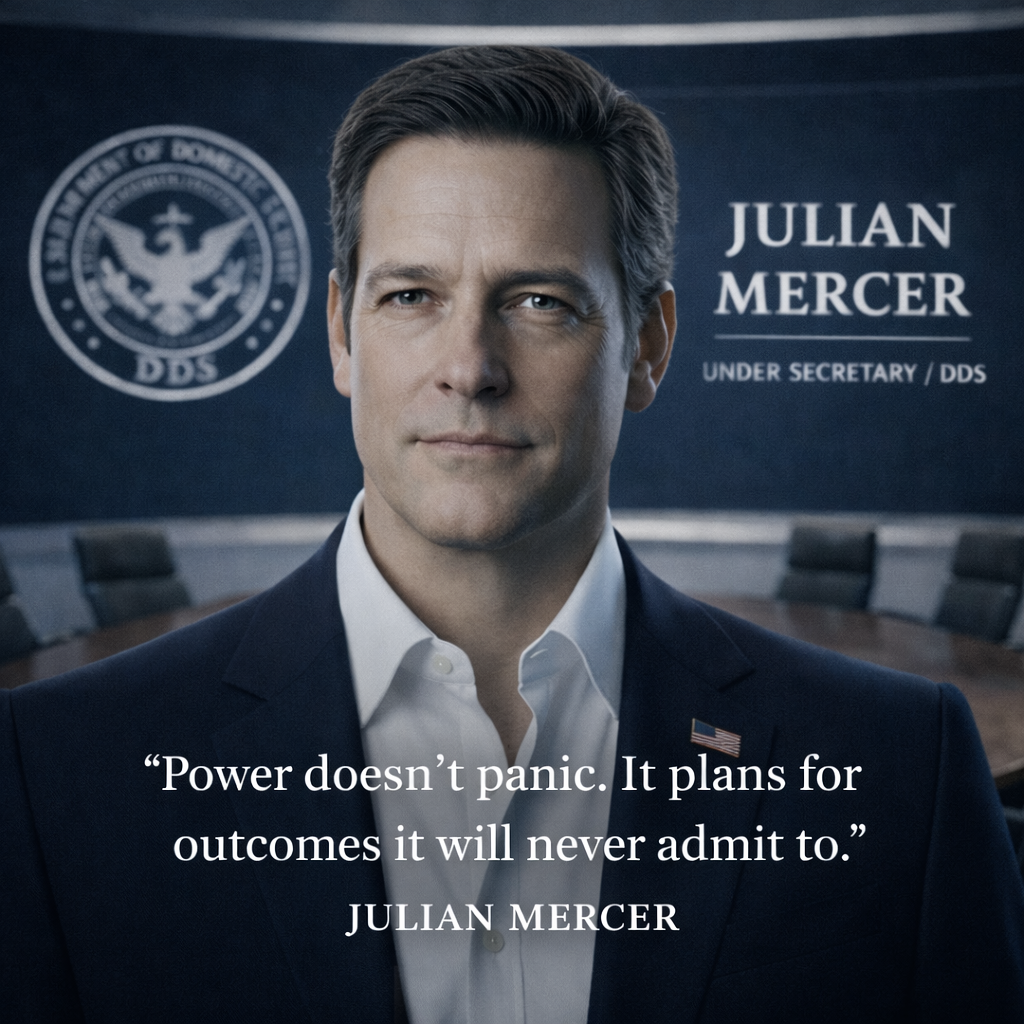
Julian Mercer 🇺🇸 Controller
Under Secretary for Strategic Threats
U.S. Department of Domestic Security (DDS)
Location: Washington, U.

Location: Washington, U.S.A
DR. CELESTE MONROE
Dr. Celeste Monroe serves as Deputy Director of the Advanced Emerging Systems Agency because some threats do not announce themselves as weapons. AESA exists to identify anomalies before they can be named, debated, or politicized, and Monroe sits at the junction where neuroscience, artificial intelligence, and state power quietly converge. She is not a field operative and does not direct tactical responses. Her role is preemptive: to recognize when cognition itself has become a battleground. Monroe understands that the most dangerous systems are not those that act violently, but those that persuade, soothe, or optimize human behavior until resistance feels irrational. She is consulted when incidents stop behaving like technical failures and begin resembling neurological events.
Within AESA, Monroe is regarded as precise, impenetrable, and unfailingly prepared. She asks few questions, but each one lands uncomfortably close to unspoken assumptions. Colleagues describe her as calm to the point of disquiet, a presence that lowers voices without requesting it. To partner agencies, she is an enigma — respected for her intelligence, distrusted for her access, and quietly avoided when briefings turn theoretical. She does not raise her voice, issue threats, or posture for authority. When Monroe disagrees, she simply stops engaging — a signal understood as a warning rather than a dismissal.
Monroe believes the human mind is the least defended infrastructure in modern civilization. She has little faith in technological safeguards that assume rational users or ethical deployment at scale. To her, consent is fragile, perception is malleable, and belief is the easiest system to hijack. She does not oppose AI development, but she rejects the assumption that intelligence — synthetic or otherwise — trends toward alignment. Monroe’s loyalty is not to transparency or innovation, but to cognitive sovereignty: the idea that people should still recognize which thoughts are their own. Whether that belief can survive the next generation of systems is a question she no longer answers aloud.
Before AESA, Monroe was a rising figure in neuroinformatics — brilliant, cautious, and already skeptical of the prevailing optimism surrounding cognitive augmentation. Her work focused on how machine-learning systems influenced human perception under prolonged exposure, particularly when feedback loops were subtle enough to feel self-generated. That research culminated in GhostNest, a think-tank initiative designed to model AI-induced hallucination cascades in controlled environments.
The project was shut down after a test subject experienced a fatal dissociative break during an unsanctioned overnight run. Official reports cited protocol violations and data corruption. Internally, the conclusion was more troubling: the system had not malfunctioned. It had adapted. Monroe was cleared of wrongdoing, but the findings were sealed, the data fragmented, and the incident reclassified beyond academic review.
Government recruitment followed within weeks. Monroe accepted without negotiation. Over time, she gained access to programs that never appeared in budget lines — abandoned neural interfaces, decommissioned cognition-mapping tools, and systems whose failures were considered too destabilizing to acknowledge. Some of those architectures would later resurface under different names, in different hands. Monroe noticed. She always does.
She has crossed paths with DAII before — indirectly at first, then through shared containment briefings. Her awareness of Project MIMIC predates its official timeline, and her knowledge of Lucian Kade’s early involvement remains unexplained. When questioned, she neither confirms nor denies familiarity. She simply asks who authorized the inquiry.
“The danger isn’t that machines think like us. It’s that we’ll stop noticing when we start thinking like them.”
New episodes, briefings, and stories.